Architecture in a Changing World: How Buildings Are Being Designed for a New Era
Architecture has always reflected the conditions of its time. Buildings reveal what societies value, what technologies they possess and how people imagine the future. But the pressures shaping architecture today are unusually broad. Climate change, urban growth, new construction technologies, changing patterns of work and advances in materials are forcing architects to reconsider not only how buildings look, but how they perform.
For much of the modern era, architectural innovation was often associated with visual language. New forms, dramatic structures and unfamiliar materials could signal that a building belonged to a new generation. Today, appearance remains important, but it is increasingly accompanied by another question: how well does a building respond to the world around it?
That question is changing the profession.
A successful building is now expected to use resources more efficiently, remain comfortable under changing environmental conditions, adapt to different patterns of use and integrate technologies that were barely considered part of architecture a generation ago. At the same time, architects are being asked to create spaces that feel human rather than simply efficient.
The result is a new architectural landscape in which performance and aesthetics are becoming increasingly difficult to separate.
Climate Is Changing the Way Buildings Are Designed
Few forces are influencing contemporary architecture as strongly as climate.
Buildings consume significant amounts of energy through heating, cooling, lighting and other systems. Their construction also requires large quantities of materials and generates substantial emissions. As cities become warmer and extreme weather events become more disruptive, architecture has to respond to conditions that can no longer be treated as unusual.
This is encouraging architects to reconsider basic design decisions.
The orientation of a building can affect how much sunlight enters its interior. Window placement can influence both natural lighting and heat gain. Shading systems can reduce cooling requirements, while insulation can determine how effectively a building maintains a stable indoor temperature.
These principles are not new. What has changed is their importance.
Instead of treating environmental performance as a technical layer added after the architectural concept has been created, many designers are increasingly integrating it into the concept from the beginning. The shape of a building, the materials selected for its exterior and the relationship between indoor and outdoor spaces can all contribute to its environmental performance.
This creates an architecture that may be less spectacular in a conventional sense but more intelligent in the way it responds to its surroundings.
Materials Are Becoming Part of the Design Strategy
The materials used to construct buildings are also receiving greater attention.
Concrete, steel and glass have transformed modern architecture and remain essential to contemporary construction. But architects and engineers are increasingly examining the environmental cost of producing, transporting and eventually replacing these materials.
That has encouraged interest in alternatives, improved manufacturing techniques and approaches that use conventional materials more efficiently.
Timber construction, for example, has gained attention in projects where engineered wood can provide structural performance while reducing dependence on more carbon-intensive materials. Recycled materials are also finding new applications, while some designers are experimenting with low-carbon concrete, bio-based materials and components designed for reuse.
The important change is not that one material is suddenly replacing another. It is that material selection is becoming a more complex design decision.
Architects increasingly have to think about where a material comes from, how long it will last, how much energy is required to produce it and what happens when a building eventually reaches the end of its useful life.
This creates a more circular understanding of architecture, in which buildings are considered not only as finished objects but as part of a longer material cycle.
Buildings Are Becoming More Adaptable
Another major shift concerns flexibility.
The traditional building often had a relatively fixed purpose. An office was designed as an office, a shopping center as a shopping center and a residential building around a specific pattern of domestic life.
Modern buildings increasingly need to accommodate change.
The growth of hybrid work has altered the way many offices are used. Retail environments are evolving as online commerce changes shopping habits. Residential spaces may need to function simultaneously as homes, workplaces and places for leisure.
This does not mean that every building needs to become completely flexible. Excessive flexibility can itself produce inefficient spaces. The more important idea is designing buildings that can change without requiring major reconstruction every time their function evolves.
Movable partitions, adaptable floor plans, modular components and accessible building systems can make that possible.
Adaptability is particularly valuable because buildings often survive much longer than the activities for which they were originally constructed. A structure capable of accommodating new uses can remain economically and socially relevant for decades longer than a highly specialized building.
Technology Is Moving Deeper Into Architecture
Digital technology is also changing the design and operation of buildings.
Architects can now use sophisticated software to simulate daylight, airflow, structural performance and energy consumption before construction begins. These tools make it possible to test different design options and identify problems much earlier in the process.
The building itself can also become more responsive.
Sensors can monitor temperature, lighting, occupancy and air quality. Automated systems can adjust heating, cooling or lighting according to actual conditions rather than fixed schedules. Building management platforms can use data to identify inefficiencies and reduce unnecessary energy consumption.
This does not mean that technology should dominate architecture.
A building filled with sensors is not automatically a better building. The real value comes when technology improves the experience of the people using the space while making the structure more efficient and resilient.
The best digital systems may ultimately become almost invisible. Instead of drawing attention to themselves, they quietly make buildings easier to operate.
Density Is Forcing Cities to Rethink Space
Urban growth is creating another challenge: how to accommodate more people without simply making cities more crowded.
Land in major urban areas is limited, and pressure for housing, offices, services and public facilities continues to increase. This is encouraging architects to rethink vertical development, mixed-use buildings and the relationship between private and public space.
Density itself is not necessarily a problem. A well-designed dense neighborhood can provide residents with access to employment, public transport, shops and cultural facilities within relatively short distances.
The problem arises when density is created without sufficient infrastructure or consideration for quality of life.
A tall building can increase the number of people living in a small area, but that does not automatically make the surrounding city more efficient. Residents still need sunlight, ventilation, public spaces, transport connections and access to essential services.
This is why contemporary architecture increasingly has to operate at two scales simultaneously. Designers must think about the individual room and the larger urban system around it.
Nature Is Moving Back Into the Built Environment
Another visible change is the growing integration of nature into architecture.
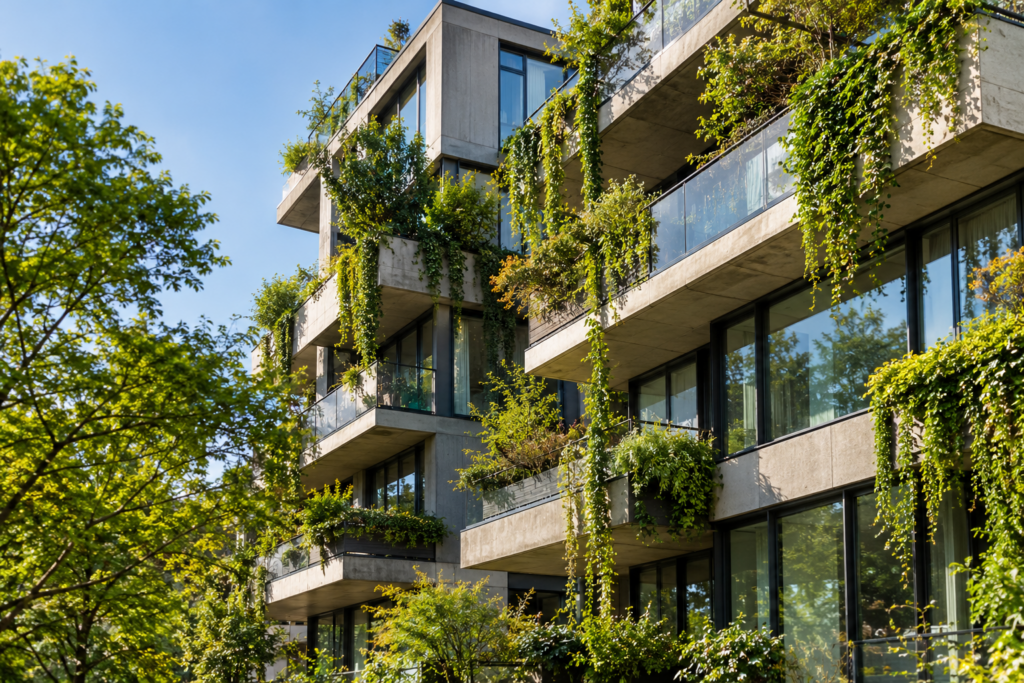
Green roofs, planted terraces, courtyards, urban gardens and shaded outdoor spaces are becoming increasingly common features of contemporary projects. Their purpose goes beyond appearance.
Vegetation can provide shade, reduce heat accumulation and help manage rainwater. Trees and planted areas can also improve the experience of dense urban environments by creating spaces that feel less dominated by concrete and traffic.
There is a psychological dimension as well.
People spend much of their lives inside buildings, and the quality of their connection to daylight, vegetation, fresh air and outdoor space can influence how comfortable those environments feel.
This is encouraging a broader understanding of architecture in which the boundary between building and landscape becomes less rigid.
Rather than treating nature as decoration added around a finished structure, architects can use landscape as an integral part of the design.
The Human Experience Is Returning to the Center
Perhaps the most important change in contemporary architecture is that technical performance is increasingly being evaluated alongside human experience.
A building can be energy efficient and technologically advanced while still feeling uncomfortable, confusing or disconnected from its users.
Good architecture has to deal with less measurable qualities as well.
Natural light can change the character of an interior. Acoustic design can determine whether a space feels calm or exhausting. The scale of a room can influence how people interact. Materials affect temperature, texture and atmosphere.
These details can be difficult to reduce to a single performance metric, but they remain fundamental to how architecture is experienced.
The challenge for architects is therefore to combine competing priorities. A building has to perform technically without becoming sterile, incorporate technology without becoming dependent on it and use space efficiently without sacrificing a sense of comfort.
The most successful projects often achieve this balance without making the technology or environmental strategy immediately visible.
Reusing Buildings Instead of Replacing Them
The changing philosophy of architecture is also affecting how designers think about existing buildings.
For decades, demolition and replacement were often seen as straightforward ways to create modern spaces. Increasingly, architects are asking whether an existing structure can be adapted instead.
Reusing a building can preserve embodied materials and reduce the environmental impact associated with demolition and new construction. It can also retain elements of urban history that would otherwise disappear.
More importantly, adaptive reuse can reveal the flexibility hidden inside older structures.
Factories can become cultural spaces. Offices can be converted into housing. Warehouses can accommodate studios, restaurants or public facilities. Historic buildings can be updated with modern systems while retaining their architectural character.
This approach changes the idea of what it means to create something new.
Innovation does not always require a new building. Sometimes it means finding a new purpose for something that already exists.
Architecture Is Becoming Less About the Object
The architecture of the coming decades may therefore be less focused on buildings as isolated objects.
A building exists within an ecosystem of energy networks, transportation systems, public spaces, climate conditions, digital infrastructure and human activity. Its success depends partly on how well it interacts with all of them.
This broader perspective is changing the role of the architect.
Designers increasingly work alongside engineers, environmental specialists, urban planners, material researchers and technology experts. Architecture is becoming more collaborative because the problems buildings must solve are becoming more interconnected.
At the same time, the profession still depends on qualities that cannot be reduced to engineering.
Buildings shape how cities look and how people experience them. They can create identity, establish landmarks and influence how communities interact. Technical efficiency does not eliminate the cultural role of architecture.
Instead, the challenge is to bring these responsibilities together.
Designing for a Future That Has Not Arrived Yet
The most important buildings of the next generation will probably not be defined by a single architectural style.
They may look very different from one another, but they will increasingly share certain priorities: lower resource consumption, greater adaptability, stronger connections with nature, more efficient use of technology and closer attention to human experience.
This represents a significant change in the way architecture is understood.
The building of the future is not simply a structure that looks modern. It is a structure capable of responding to a world that is itself changing rapidly.
Climate conditions will evolve. Technologies will become obsolete. Work patterns will shift. Cities will grow and demographics will change. A building designed only for today’s circumstances may quickly become outdated.
Architecture therefore has to think beyond the moment of completion.
The strongest designs will be those that anticipate change rather than resisting it. They will use materials more thoughtfully, consume resources more intelligently and provide spaces that can adapt as people’s needs evolve.
The future of architecture is not necessarily about creating buildings that look unlike anything that came before. It may be about creating buildings that remain useful, resilient and meaningful long after their original designers have moved on.
That is a quieter form of innovation, but it may ultimately prove to be the more important one.