The New Language of Interior Design: How Modern Spaces Are Becoming More Personal
Interior design is changing in a way that is easy to notice but harder to define. The polished rooms that once dominated magazines and property advertisements are giving way to spaces that feel more individual, more adaptable and, in many cases, less concerned with following a single visual formula.
For years, contemporary interiors were strongly associated with minimalism. Clean lines, neutral colors, open layouts and carefully controlled decoration became the visual language of modern living. That approach remains influential, but it is no longer the only definition of a well-designed space.
People are asking different questions about their surroundings.
Can a room support several activities without feeling improvised? Can a home feel technologically advanced without looking like a showroom? Can furniture be comfortable as well as beautiful? Can an interior reflect the personality of its occupants rather than reproduce a style seen thousands of times online?
These questions are changing the priorities of designers.
The new language of interior design is less about creating a perfect visual composition and more about creating spaces that work naturally with the lives taking place inside them.
The End of the One-Style Interior
One of the most noticeable changes in contemporary interiors is the gradual move away from strict stylistic consistency.
For a long time, rooms were often designed around a clearly defined aesthetic. A designer might select a particular style and ensure that furniture, lighting, colors and decorative objects all followed the same visual rules.
Today, many interiors are more eclectic.
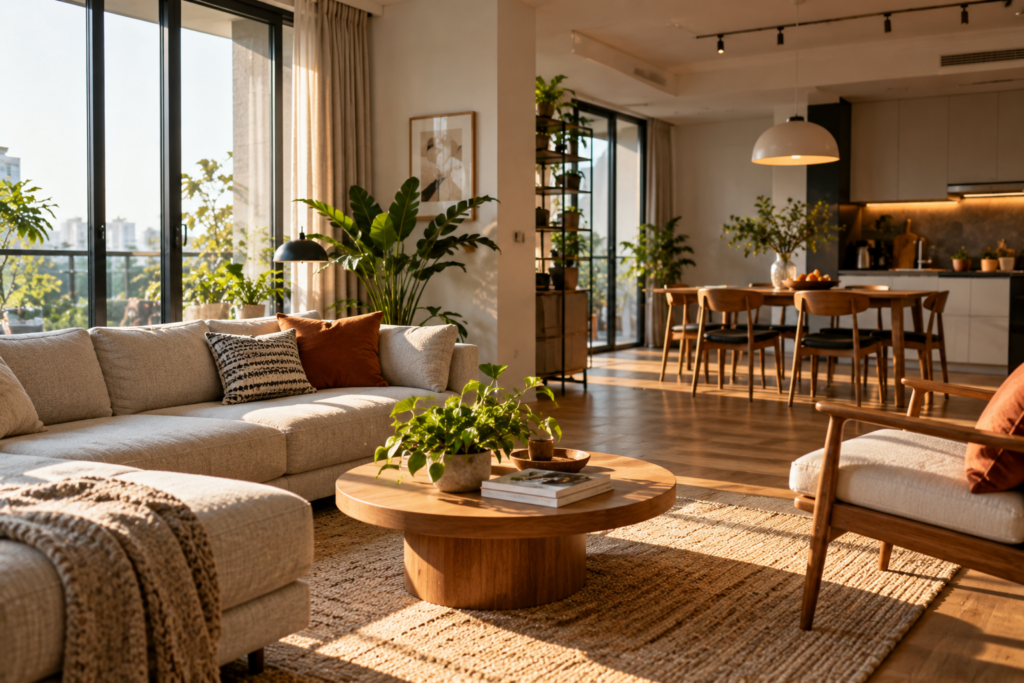
A contemporary sofa may sit beside an older wooden table. Modern lighting can coexist with handmade ceramics, vintage furniture or objects collected during travel. Architectural details that would once have been covered or simplified may now become focal points.
This does not mean that designers have stopped caring about visual coherence. Instead, coherence is increasingly created through proportion, texture, materials and color rather than through matching every object.
The result can feel more personal because the room appears to have developed over time rather than being purchased as a complete package.
That distinction matters in an era when digital platforms have made visual inspiration almost limitless. When everyone has access to the same images, creating a space that feels genuinely individual becomes more difficult.
Personal history becomes part of the design.
Homes Are Doing More Work
The transformation of interior design is also closely connected to changing patterns of everyday life.
The traditional division between rooms has become less rigid. A kitchen can function as a dining area, social space and informal workplace. A living room may also contain a desk. Bedrooms increasingly need to accommodate storage, exercise or quiet work.
The growth of remote and hybrid work accelerated this shift, but the underlying change is broader. People increasingly expect their homes to support several aspects of life without requiring a separate room for every activity.
This has made flexibility one of the most important principles in contemporary interior design.
Furniture can be moved or folded away. Storage is integrated into walls and built-ins. Lighting can be adjusted according to activity. Sliding doors and movable partitions can change the relationship between rooms.
The objective is not simply to save space.
A flexible interior allows people to change how they use a room throughout the day. The same area can feel open and social at one moment and private and focused several hours later.
Good design is increasingly about giving people control over their environment.
Comfort Is Becoming More Important Than Perfection
The highly controlled interiors of previous decades often emphasized visual perfection. Every object appeared to have a predetermined place, surfaces were exceptionally clean and decorative elements were carefully limited.
Contemporary design is becoming more comfortable with imperfection.
Natural wood can show variations in grain. Stone can have irregular surfaces. Textiles may be chosen for their tactile qualities rather than their pristine appearance. Handmade objects can introduce small differences that would be considered flaws in mass-produced products.
This reflects a broader interest in authenticity.
People increasingly want interiors that feel pleasant to inhabit rather than spaces that exist primarily to be photographed. A room can be sophisticated without feeling fragile, and elegant without requiring constant maintenance.
That shift is particularly visible in the growing importance of texture.
Soft fabrics, natural timber, woven materials, ceramics and textured walls can create visual depth without relying on excessive decoration. Instead of filling a room with objects, designers can make a smaller number of materials carry more of the visual character.
The result is often quieter but also more inviting.
Natural Materials Are Doing More Than Making Rooms Look Warm
The renewed interest in natural materials is not simply an aesthetic trend.
Wood, stone, wool, linen, clay and other tactile materials can influence how people experience a room. They introduce variation, texture and a sense of physical presence that can be difficult to achieve with completely uniform synthetic surfaces.
This is especially relevant as more of everyday life becomes digital.
Screens, smartphones and connected devices create environments dominated by visual information. Interiors built around natural textures can provide a contrasting sensory experience.
There is also a growing interest in understanding where materials come from and how long they will last. Designers and clients are increasingly considering durability, repairability and the environmental impact of materials alongside appearance.
That does not mean every modern interior has to look rustic or deliberately natural.
Technology and natural materials can work together effectively. A sophisticated lighting system can illuminate timber surfaces. Smart climate controls can operate within a room filled with traditional furniture. Contemporary architecture can provide the structure while handcrafted elements give the interior its character.
The most interesting spaces often emerge from this combination rather than from choosing one side over the other.
Lighting Is Becoming an Architectural Element
Lighting has always been important in interior design, but its role is becoming increasingly sophisticated.
Instead of treating lighting as something added after furniture and finishes have been selected, designers increasingly use it to shape the entire experience of a room.
Natural daylight remains fundamental. Large windows, skylights and carefully positioned openings can make interiors feel larger and more connected to the outside world.
Artificial lighting then extends that flexibility into the evening.
Different layers of light can create different atmospheres without changing the physical arrangement of the room. Task lighting can support focused work, indirect illumination can create a softer environment for relaxation and accent lighting can draw attention to architecture or objects.
The result is an interior that changes throughout the day.
This is particularly important in flexible spaces. A room does not have to be redesigned every time its function changes if lighting can help redefine the atmosphere.
Technology is making this easier through adjustable color temperature, dimming systems and automated controls. But the principle remains fundamentally architectural: light determines how people perceive space.
Technology Is Becoming Less Visible
Smart-home technology has introduced another interesting development.
Early connected homes often celebrated technology visually. Large screens, prominent control panels and complex devices became symbols of modernity.
The direction is now increasingly different.
The best technology is often the technology that does not demand attention.
Heating and cooling systems can adjust automatically. Lighting can respond to occupancy or time of day. Window coverings can change according to sunlight. Security systems can operate in the background.
This creates a more subtle relationship between technology and design.
Rather than making a home look more technological, designers are trying to make technology disappear into the architecture.
That shift is important because interiors are ultimately human environments. People want the benefits of automation without necessarily wanting to live inside a machine.
Small Spaces Are Encouraging Better Design
Rising property costs and increasing urban density are also influencing interior design.
When space is limited, every square meter becomes more important. This has encouraged designers to reconsider conventional assumptions about furniture, storage and room layouts.
Built-in storage can eliminate visual clutter. Furniture can perform several functions. Vertical space can become useful storage or display area. Sliding doors can reduce the amount of space required for circulation.
But the best small interiors do not simply attempt to fit more things into less space.
They prioritize.
A room can feel larger when it contains fewer unnecessary objects, allows natural light to move through it and maintains clear visual connections. Proportion becomes particularly important because oversized furniture can quickly overwhelm a compact interior.
Small-space design is therefore becoming less about compromise and more about efficiency.
A carefully designed small apartment can sometimes feel more comfortable than a much larger home in which space has been poorly organized.
The Return of Color and Character
The dominance of neutral interiors is also beginning to weaken.
White, beige, gray and other muted tones remain popular because they create calm backgrounds and work well with a wide range of materials. But designers are increasingly using stronger colors to give spaces more identity.
The change is not necessarily a return to maximalism.
A single deep-colored wall, an unusual piece of furniture or a collection of contrasting objects can create character without overwhelming the room. Color can also be used to distinguish different functions within an open-plan space.
This reflects the larger movement toward individuality.
After years in which interior design was heavily influenced by standardized visual trends, people are becoming more willing to make choices that are personally meaningful even when those choices do not fit a single established aesthetic.
The modern interior can therefore be calm and expressive at the same time.
Design Is Becoming More Personal Because Life Is Becoming More Individual
Perhaps the biggest transformation in interior design is not technological or stylistic. It is cultural.
People increasingly expect their surroundings to reflect the way they actually live.
A home is no longer necessarily organized around a fixed sequence of rooms and predetermined functions. Work, entertainment, family life, exercise, socializing and relaxation can happen in overlapping spaces.
That requires a different approach to design.
Instead of asking what a modern interior is supposed to look like, designers increasingly have to ask who will use it, what they need from it and how those needs may change.
This makes personalization more than a decorative trend.
It affects the layout, furniture, lighting, materials and technology of the entire space.
The Future of Interior Design May Be Less About Trends
Interior design will always have trends. Certain materials, colors and forms will become fashionable and eventually give way to something else.
But the deeper change taking place now is likely to last longer than any individual trend.
People want spaces that can adapt. They want comfort without sacrificing design quality, technology without visual clutter and individuality without abandoning functionality. They are also becoming more conscious of materials, durability and the relationship between their interiors and the wider environment.
That points toward a more mature understanding of design.
The successful interior of the future may not be the one that looks most fashionable when it is first completed. It may be the one that continues to feel useful and personal as the people living in it change.
A well-designed space should be able to accommodate a new piece of furniture, a different working routine, a growing family, changing interests or simply the passage of time.
That is why the new language of interior design is becoming less rigid.
The most compelling spaces are no longer necessarily those that look perfect from a distance. They are the ones that make sense when someone actually lives inside them.