Art in the Age of AI: How Technology Is Changing Creativity
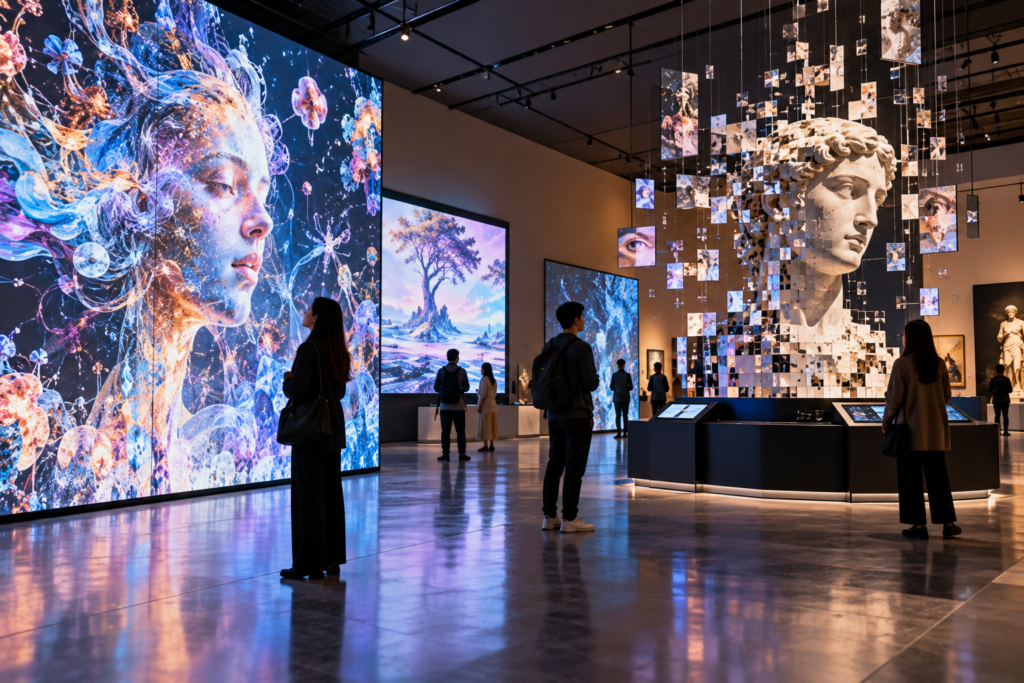
For centuries, artists have worked with tools that placed clear limits on what could be made and how quickly it could be produced. A painter had pigments, brushes and a physical surface. A sculptor worked with stone, wood or metal. Photography introduced an entirely different relationship with reality, while computers and digital editing later transformed the production and distribution of images. Each technological shift changed artistic practice, but the basic relationship between an idea, a human creator and a finished work remained relatively easy to understand.
Generative artificial intelligence is changing that relationship in a more fundamental way.
A person can now describe an image in ordinary language and receive a finished visual composition within seconds. The same technology can generate variations, transform existing material, produce animation, assist with music and help explore creative possibilities that would previously have required specialized technical skills. The important change is not simply that computers have become better at making images. It is that the distance between an idea and its visible expression has become dramatically shorter.
That development is already affecting the cultural world. Museums are incorporating AI into exhibitions and collection research, artists are using it as part of their creative processes, and cultural organizations are beginning to examine how the technology should be governed. A 2026 UNESCO–ICOM survey of more than 400 museums in 90 countries found that 57% of responding institutions were already using AI, although 55% had no internal AI policy, strategy or guidelines. The survey identified accuracy, copyright and data protection among the leading concerns.
The speed of adoption is therefore creating a difficult cultural moment. The technology is moving faster than many of the rules, habits and professional expectations surrounding it. For artists, the central question is no longer simply whether AI should be used. It is becoming a much more complicated question of what human creativity means when a machine can participate directly in the process of making.
From Digital Tool to Creative Environment
It is tempting to describe generative AI as simply another tool, but that comparison only goes so far. A brush does not suggest what to paint. A camera does not decide which photograph should matter. Even sophisticated digital editing software generally requires a person to make most of the creative decisions.
Generative systems introduce a different kind of relationship because they can produce possibilities on their own once a person establishes a set of instructions. The artist can describe a scene, request a particular transformation, reject the result and try again. The process becomes iterative, with the machine producing possibilities and the human deciding which ones deserve further attention.
This changes the nature of creative labor.
An artist may spend less time manually producing every component of an image and more time developing concepts, refining instructions, comparing variations and editing the material that emerges. The work can become less about executing a predetermined image and more about creating a process through which unexpected results can appear.
That does not make the human contribution disappear. In some circumstances, it can make judgment more important. When a system can produce hundreds of possible images in a short period, the difficult question becomes deciding why one of them should survive while the others are discarded.
The abundance of possibilities can therefore create a new kind of creative responsibility.
When Making Becomes Easy, Choosing Becomes Harder
Traditional artistic production has always involved selection, but physical limitations placed natural boundaries on the process. A painter could not create thousands of finished compositions in an afternoon. A photographer working with film had to think carefully about each exposure. A sculptor could not test an unlimited number of finished forms without investing substantial time and material.
Generative AI removes part of that friction.
An artist can now explore dozens of visual directions before committing to one. A designer can test radically different compositions without constructing each one from the beginning. A filmmaker can visualize possibilities before deciding which scenes deserve to enter production.
This can be liberating because experimentation becomes cheaper.
At the same time, unlimited generation can create a new problem: the world becomes filled with material that is easy to produce but difficult to distinguish. If millions of people work with similar systems and similar datasets, certain visual conventions can spread rapidly. Images may become technically polished while also becoming increasingly predictable.
UNESCO has raised precisely this concern, noting that generative AI can encourage standardized and predictable outputs and shift an important cultural challenge away from simply creating forms toward deciding how those forms should be evaluated and understood. The organization argues that human intention, originality and accountability remain central to artistic value.
This may become one of the defining tensions of AI-assisted art. When production is abundant, scarcity moves elsewhere. The scarce resource becomes attention, judgment and the ability to say why a particular work deserves to be seen.
The Question of the Training Data
Behind every discussion about AI-generated art is a much larger issue that is less visible in the finished image: the material used to train the system.
Generative models learn from enormous quantities of existing cultural content. Depending on the system and its training process, those datasets may include images, books, photographs, music, articles and other forms of human-created work. This has created serious concerns among artists and other creators who argue that their work can contribute to the development of commercial AI systems without their permission or compensation.
The controversy is difficult because training is not necessarily equivalent to producing a direct copy. A model can absorb patterns from a vast collection of material and then generate something that does not reproduce any single source exactly. Yet the original cultural material still has value because the performance of the system depends heavily on the quality and diversity of the data from which it learned.
UNESCO’s 2026 discussion of AI and creation emphasizes this problem directly, noting that training datasets can contain cultural works whose rights holders have not authorized their use and who may receive no compensation. The organization also points to the wider question of how value should be shared between technology companies and the creators whose work contributes to the cultural ecosystem on which these systems depend.
This is why the debate around AI art cannot be reduced to the question of whether a generated image looks original. The deeper issue is the relationship between creative labor and the infrastructure that now processes enormous amounts of culture.
If artistic work becomes the raw material for a technology that can subsequently compete with artists in the same market, the economic consequences are difficult to ignore.
Copyright Is Becoming Part of the Creative Process
The legal questions that follow are equally complicated.
Traditional copyright systems were designed around identifiable human creators and recognizable works. Generative AI introduces situations in which a person may write a detailed prompt, repeatedly refine the output, select one result and then substantially edit it. Another person may enter a very short instruction and use the first result without modification. Both may describe what they have done as “creating an image with AI,” but the degree of human creative contribution is obviously different.
This makes authorship harder to define.
The problem also extends to the relationship between an AI-generated work and existing artistic styles. A user can request an image that resembles a particular visual tradition or, more controversially, asks for something “in the style” of a living artist. The resulting image may not reproduce a particular work, yet it can raise questions about whether the system is commercially exploiting an artist’s distinctive creative identity.
There is no single international answer to these questions.
Different legal systems are approaching AI, copyright and training data in different ways, while artists, technology companies and cultural institutions continue to argue over where the boundaries should lie. UNESCO’s 2026 cultural policy work identifies AI, creators’ rights and the economic sustainability of cultural professionals as major issues requiring new policy responses.
For artists, this uncertainty is not abstract. Copyright determines who can control a work, who can license it and who can earn money from it. As AI becomes more deeply embedded in professional creative practice, those questions will become part of everyday artistic business rather than occasional legal disputes.
Museums Are Becoming Places to Debate AI
Cultural institutions are responding to the technology in ways that reveal how quickly the subject has moved beyond the world of experimental software.
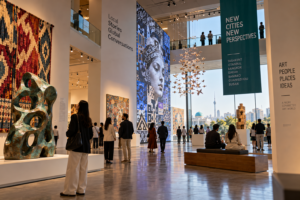
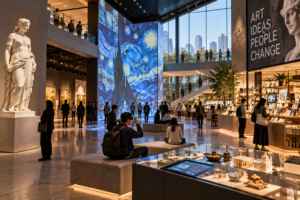
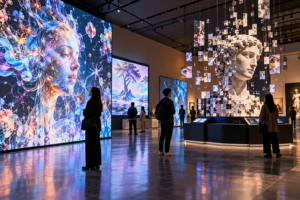
In 2026, the Smithsonian presented Smithsonian Dreams, an immersive public artwork by Refik Anadol that uses a custom AI system and millions of digitized objects from Smithsonian collections to create a continuously evolving visual experience across the historic Smithsonian Castle. The project treats AI not simply as a production technique but as a way of reinterpreting a vast body of institutional knowledge.
At the same time, museums are creating exhibitions that examine AI critically rather than simply celebrating its possibilities. The MSU Museum’s Reality Check, which opened in September 2026, brings together artists, researchers, technologists and students to explore how AI is changing ideas about truth, identity, creativity and democracy.
Frankfurt’s SCHIRN Kunsthalle has taken a similar approach with The World Through AI, an exhibition examining the political, psychological, environmental and cognitive consequences of AI-generated images and systems. Another 2026 exhibition at the Museum Angewandte Kunst, AI-Worlding, explores how generative systems create representations of the world from selective and potentially unrepresentative datasets.
Taken together, these projects reveal an important change in the cultural conversation. AI is no longer being presented only as a new artistic medium. It has become a subject through which museums can examine questions about knowledge, representation and power.
The artwork becomes part of the argument.
AI Can Make Creative Experimentation More Accessible
The debate about AI is often dominated by its risks, but its potential benefits are significant as well.
Generative tools can reduce some of the technical barriers that have historically prevented people from experimenting with visual art, animation, music or other forms of creative production. Someone who has an idea but lacks advanced drawing skills can create a visual prototype. A filmmaker can explore a scene before investing in production. A designer can test different directions before committing to a final concept.
This does not mean that technical accessibility automatically produces artistic quality. Knowing how to generate an image is not the same as knowing why an image should exist. But the ability to experiment can still be valuable because experimentation is an important part of creative development.
The same is true for professional artists.
An illustrator may use AI to explore compositions before drawing the final work. A photographer may use it to investigate visual possibilities during pre-production. A filmmaker can use generated material as a reference or storyboard. An artist working with installation can test spatial concepts before constructing them physically.
In these cases, AI becomes one stage in a larger process rather than the complete creative process.
That distinction may prove increasingly important as artists develop their own ways of combining machine-generated material with photography, painting, sculpture, video, performance and other established practices.
The Human Trace May Become More Valuable
There is also a cultural reason why human-made art may remain important even as generated images become ubiquitous.
Art often carries evidence of its making. A brushstroke reveals movement and pressure. A photograph records a particular encounter with the world. A handmade object contains small irregularities. Even highly polished digital work can reveal decisions about composition, editing and timing that belong to a particular creator.
Generative systems can produce visually polished material with remarkable speed and consistency. That consistency can be useful, but it can also make images feel interchangeable.
As synthetic content becomes more common, audiences may become increasingly interested in the circumstances behind a work. Who made it? Why was it made? What experience produced the idea? What decisions were made during the process? Which parts were generated and which were shaped by a person?
These questions can become part of the meaning of the work itself.
In that sense, AI may paradoxically increase the cultural value of human intention. When the ability to produce an attractive image becomes widely available, the reason for making that particular image becomes more significant.
Creativity Is Moving From Execution Toward Direction
The most interesting long-term change may therefore be a shift in what creative skill looks like.
For many artists, technical execution will remain essential. Painting, sculpture, photography, animation and other disciplines require knowledge that cannot be replaced simply by generating an image. But AI adds another layer in which the artist’s ability to direct a system, evaluate its results and integrate them into a larger concept becomes part of the creative process.
This can be compared with earlier technological shifts, although the comparison should not be taken too literally.
Photography did not eliminate painting, but it changed what painting needed to do. Digital tools did not eliminate photography, but they changed how photographs were produced and edited. Computer-aided design did not remove the architect, but it changed the relationship between drawing and construction.
Generative AI is likely to create a similar transformation, although its reach across different creative disciplines makes it unusually broad.
The artist may increasingly become the person who establishes the question, sets the constraints, evaluates the possibilities and decides when the process has produced something worth keeping.
The machine can generate. It cannot automatically determine what matters.
A New Cultural Divide May Emerge
There is another issue that deserves attention: access.
The benefits of AI will not necessarily be distributed evenly. Artists with access to powerful hardware, sophisticated software, reliable digital infrastructure and technical education will have more opportunities to experiment than those without them.
UNESCO’s current cultural analysis warns that AI could contribute to a “two-speed” creative economy in which people and communities with weaker digital infrastructure fall further behind. The organization also points to the risk that AI systems may reproduce dominant cultural narratives if their datasets and development processes are not sufficiently diverse.
This matters because culture is not simply a collection of universally shared images.
Different societies have different visual traditions, languages, histories and ways of representing the world. If generative systems learn disproportionately from already dominant cultural material, their outputs can reinforce those dominant perspectives.
The issue is therefore not only who can use AI, but whose culture becomes most visible through it.
That question will become increasingly important as museums, publishers, advertisers and entertainment companies begin incorporating generated material into mainstream cultural production.
What Happens When the Machine Can Make the Image?
The arrival of generative AI does not make the old definition of an artist completely useless, but it does make it less complete.
For centuries, creative identity was closely associated with the ability to transform an idea into a physical or digital work through a particular set of skills. Now part of that transformation can be delegated to a machine.
The consequence is not necessarily the disappearance of human creativity. It may instead force culture to place greater emphasis on the parts of creativity that machines cannot settle for us: intention, judgment, context, experience and responsibility.
That is why the current debate is ultimately larger than AI-generated images.
It is about who controls cultural production, whose work provides the material from which new systems learn, how artists are compensated and how audiences distinguish meaningful creative expression from an endless stream of technically competent content.
The answers will not come from technology alone. Museums, artists, lawmakers, educators and audiences will all influence what becomes normal.
For now, the most convincing direction is not to treat AI as either the enemy of art or its inevitable replacement. The technology is becoming another part of the creative environment, and its cultural value will depend on how deliberately people use it.
Art has survived every major technological transformation because its purpose has never been limited to demonstrating technical skill. People make art to record experience, express ideas, question authority, preserve memory and imagine possibilities that do not yet exist.
AI can accelerate the process of making.
What it cannot decide on its own is what is worth saying.
That decision remains at the heart of creativity, and it may become even more important in a world where almost anyone can generate an image in seconds.