The New Museum: How Cultural Institutions Are Reinventing the Way We Experience Art
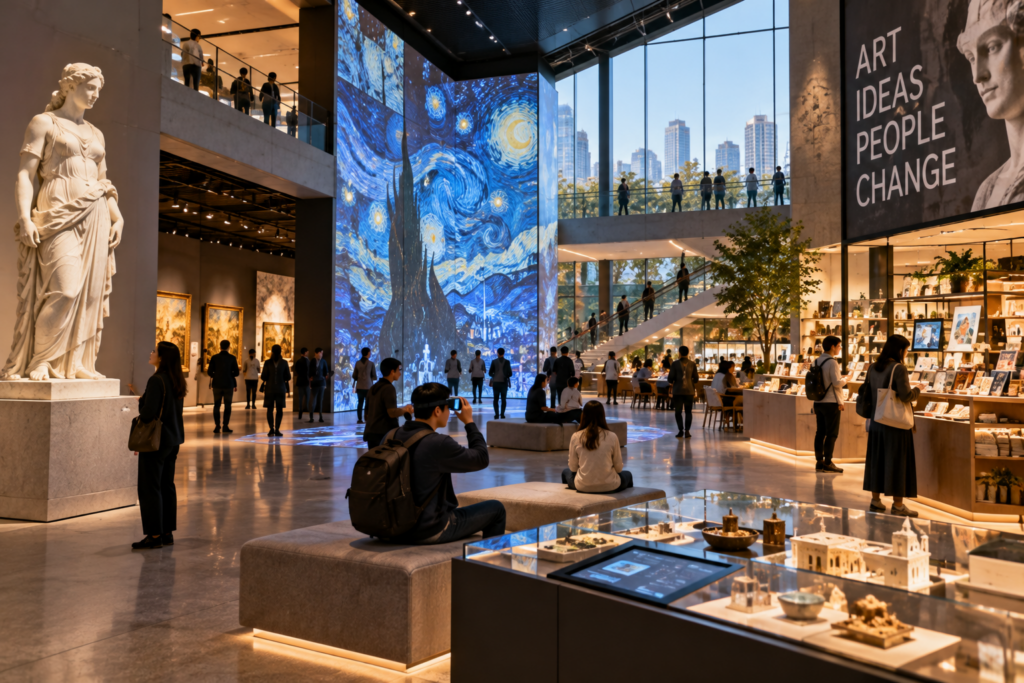
For much of its modern history, the museum had a relatively clear role. It collected important objects, preserved them, displayed them and provided visitors with a physical place in which to encounter art, history or science. The basic relationship was straightforward: the institution held the collection, the exhibition presented it and the visitor came to see it.
That model is changing.
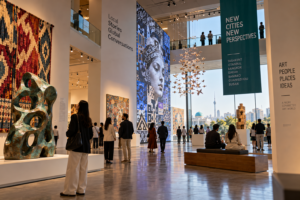
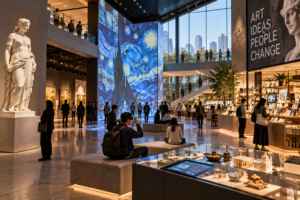
Museums are increasingly becoming places for discussion, education, performance, digital experimentation, social activity and immersive experiences. Their collections still matter, but the way those collections are interpreted and experienced is becoming almost as important as the objects themselves.
The shift is partly cultural and partly economic. Audiences have become accustomed to interactive digital environments, personalized recommendations and experiences that combine several forms of media. At the same time, museums are facing rising operating costs and pressure to diversify their sources of income. In the United Kingdom, for example, government-sponsored museums and galleries generated £563 million in self-generated income in 2024–25, a 53% real-terms increase compared with 2021–22.
The result is a new kind of museum: one that still protects the past, but increasingly operates as a platform for experiences, ideas and relationships.
The Museum Is Becoming an Experience
The most visible change is happening inside exhibition spaces.
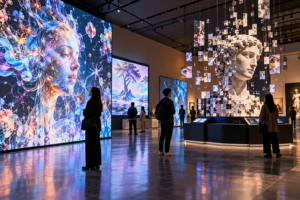
Visitors are no longer necessarily expected to stand in front of an object, read a label and move to the next display. Digital projections, augmented reality, virtual reality, interactive screens, spatial audio and other technologies can create additional layers of interpretation.
The purpose, however, is becoming more sophisticated than simply making exhibitions more spectacular.
A recent study from Science Tokyo, published in 2026, examined how visitors responded to digital museum experiences and found that emotional connections to personal memories, historical stories and cultural heritage played an important role in engagement. The research suggests that technology is most effective when it strengthens the connection between a visitor and the cultural material rather than simply adding visual effects.
That distinction matters.
A giant projection can attract attention, but attention is not the same as understanding. Museums are increasingly discovering that immersive technology works best when it helps visitors explore a subject in a way that would be difficult through conventional displays.
The strongest digital experiences therefore do not compete with the collection. They give visitors another way to enter it.
Immersion Is Moving Beyond the Spectacle
Immersive exhibitions have become one of the most visible developments in the cultural sector, but the format itself is evolving.
Early immersive experiences often focused heavily on scale: enormous projections, dramatic music and environments designed to make visitors feel as if they had stepped inside an artwork or historical setting. That model remains popular, but audiences are becoming more familiar with it.
The question is increasingly what happens after the initial sense of wonder.
A 2026 discussion with the Museums Association about immersive exhibition design highlighted a growing expectation that visitors should receive both meaningful participation and substantive content. The organization behind the Timewalk experience in London argued that spectacle alone is no longer sufficient and that interpretation and storytelling are becoming more important.
That represents an important maturation of the format.
Immersion can be useful when it creates context. Ancient architecture can be reconstructed at a scale that allows visitors to understand how a space might have worked. A historical environment can be explored from different perspectives. A scientific process can be visualized in three dimensions.
In these cases, technology becomes a tool for explanation rather than decoration.
The museum of the future may therefore be less interested in making visitors say “wow” and more interested in making them curious enough to ask what comes next.
Digital Technology Is Expanding the Museum Beyond Its Walls
The physical museum is not disappearing. Instead, its boundaries are becoming less rigid.
Digital collections, virtual exhibitions, 3D models, online learning resources and interactive archives allow people to encounter cultural material without being physically present. This can be particularly valuable for people who live far from major institutions or have difficulty accessing conventional museum spaces.
Recent research into digital museum experiences has also explored technologies such as digital humans, which can provide new ways of interpreting collections and cultural heritage. A 2026 study in npj Heritage Science examined the factors influencing visitors’ willingness to engage with museum digital humans, including information quality, aesthetic experience and the sense of immersion created by the technology.
The development raises an interesting possibility: the museum may increasingly exist in several forms at once.
There is the physical institution, with its architecture and galleries. There is the digital version, accessible from a home computer or mobile device. There are immersive experiences that can travel to other venues. There are educational resources that can reach classrooms and communities that may never visit the original building.
These formats do not necessarily compete.
They can create different entry points into the same collection.
The Audience Is Becoming Part of the Design
The traditional museum model often assumed that visitors would adapt themselves to the institution. They arrived during opening hours, followed a predetermined exhibition route and consumed information largely at the pace established by the display.
Contemporary museums are increasingly designing around the visitor instead.
That can mean providing multiple levels of information, allowing people to choose between short and detailed explanations, creating spaces for discussion or designing exhibitions around different forms of participation.
Digital technology makes this easier because content can be layered. A visitor who wants a quick overview can receive one level of information, while another visitor can explore deeper historical context, related objects or specialist material.
This approach also changes the role of museum educators.
Education is becoming less about delivering information in one direction and more about creating opportunities for people to explore questions. Workshops, talks, family programs, creative activities and interactive interpretation can turn a museum visit into a much more active experience.
The museum becomes less like a library of finished answers and more like a place where curiosity can develop.
Artificial Intelligence Is Entering the Museum Too
The next layer of change is already arriving through artificial intelligence.
AI can help museums interpret large collections, generate translations, improve search and discovery, create personalized explanations and support digital experiences. It may also allow institutions to make collections accessible in languages or formats that were previously difficult to provide.
But the arrival of AI creates a particularly important question for cultural institutions: who should explain the collection?
Museums have traditionally built authority around curators, historians, conservators and other specialists. AI introduces a new interface between the institution and its audience, but that interface can sometimes produce information that is incomplete or inaccurate.
A 2026 report on AI and museums found that many visitors are already turning to general-purpose AI systems for museum-related information. The research suggests that museums retain a high level of trust, but risk losing control over the interface through which audiences access their knowledge.
That is a significant development.
The museum may no longer be the only place where a visitor asks, “What am I looking at?” Increasingly, that question can be directed to an AI assistant before, during or after a visit.
For museums, the response is unlikely to be simply rejecting the technology. The more interesting challenge is finding ways to make authoritative museum knowledge more accessible within the new digital environment.
Collections Are Becoming Cultural Brands
There is another transformation taking place outside the galleries.
Museums are increasingly recognizing that their collections possess cultural value that can extend into publishing, design, fashion, home goods, entertainment and other forms of collaboration.
This is partly an economic response. Cultural institutions face substantial costs, and many cannot rely exclusively on public funding or ticket sales. But licensing can also extend the reach of a collection beyond the museum itself.
Recent industry data illustrates how quickly this area is developing. According to Licensing International, the global art property category grew 5.7% in 2025, its fourth consecutive year of growth, while location-based experiences and themed attractions increased by 6%.
Museums are participating directly in that expansion.
Recent reporting has highlighted partnerships involving institutions such as the British Museum, the Victoria and Albert Museum and Tate, with cultural collections appearing in products, fashion collaborations, technology partnerships and immersive experiences.
This creates a new relationship between the museum and everyday culture.
A visitor may encounter a work of art first in a gallery, then see it referenced in a book, design object or digital experience. The collection becomes part of a wider cultural ecosystem rather than something encountered only during a museum visit.
Commercialization Has to Be Handled Carefully
The expansion into licensing and commercial partnerships is not without risks.
Museums possess cultural authority partly because they are not simply commercial enterprises. If every important collection becomes a marketing opportunity, institutions could weaken the trust that makes their brands valuable in the first place.
The strongest partnerships therefore tend to be those that make sense culturally.
A reproduction of an artwork in a well-designed publication can extend access to the work. A collaboration with a designer can encourage people to engage with a collection in a new context. An immersive experience can introduce historical material to people who might never have visited a traditional museum.
The commercial activity becomes problematic when the connection to the collection feels arbitrary.
This is why authenticity matters.
Licensing specialists working with museums increasingly emphasize partnerships that are consistent with an institution’s identity and respectful of artists’ rights. The objective is not simply to put a famous image on as many products as possible, but to create an extension of the cultural experience.
In that sense, the new museum is learning a lesson familiar to the creative industries: audiences can recognize the difference between a meaningful collaboration and a marketing exercise.
The Museum Is Becoming a Social Space
Perhaps the most important change is less technological.
Museums are increasingly functioning as places where people spend time rather than simply places they visit to see an exhibition. Talks, workshops, performances, restaurants, cafés, family programs and community events can make the institution part of the social life of a city.
This reflects a broader understanding of cultural participation.
People may visit a museum because they are interested in a particular exhibition, but they may return because the institution has become a place where they learn, meet other people or participate in something.
The physical building therefore remains extremely important.
Digital experiences can extend a museum’s reach, but they cannot fully replace the experience of standing in a historic gallery, encountering an original object or sharing a cultural experience with other people in the same room.
Recent sector research continues to show that digital engagement is growing alongside physical participation rather than simply replacing it. In England, 45% of adults engaged with museums or galleries in 2025–26, while digital engagement reached 15%, up from 9% when the survey began in 2021–22.
The future is therefore likely to be hybrid.
What the Museum Becomes Next
The museum of the future may not have a single defining format.
Some institutions will remain deeply focused on collections and scholarship. Others will develop immersive experiences, educational programs or community functions. Many will combine several of these roles.
What connects them is a shift in emphasis.
The museum is no longer defined only by what it owns. It is increasingly defined by what it allows people to do with what it owns: understand it, question it, reinterpret it, experience it, discuss it and carry it into other parts of their lives.
That is why technology alone will not determine the future of museums.
Virtual reality, artificial intelligence, digital humans and interactive installations can all expand what an institution can offer, but none of them automatically creates a meaningful cultural experience. The difficult work remains curatorial and human: choosing the right story, establishing context, respecting evidence and giving visitors a reason to care.
The most successful museums will probably be those that understand this distinction.
They will use technology without becoming technology companies. They will develop commercial partnerships without allowing commerce to define their cultural purpose. They will expand beyond their walls without losing the importance of the physical encounter.
The museum is changing because the relationship between people and culture is changing.
The institution that once asked visitors to come and look is becoming a place that invites them to participate, explore and return. Its collection remains at the center, but around that collection a much larger world of experiences is beginning to emerge.
The new museum is not abandoning the past. It is finding more ways to make the past active in the present.