Why Art Is Becoming More Global: The New Geography of Culture
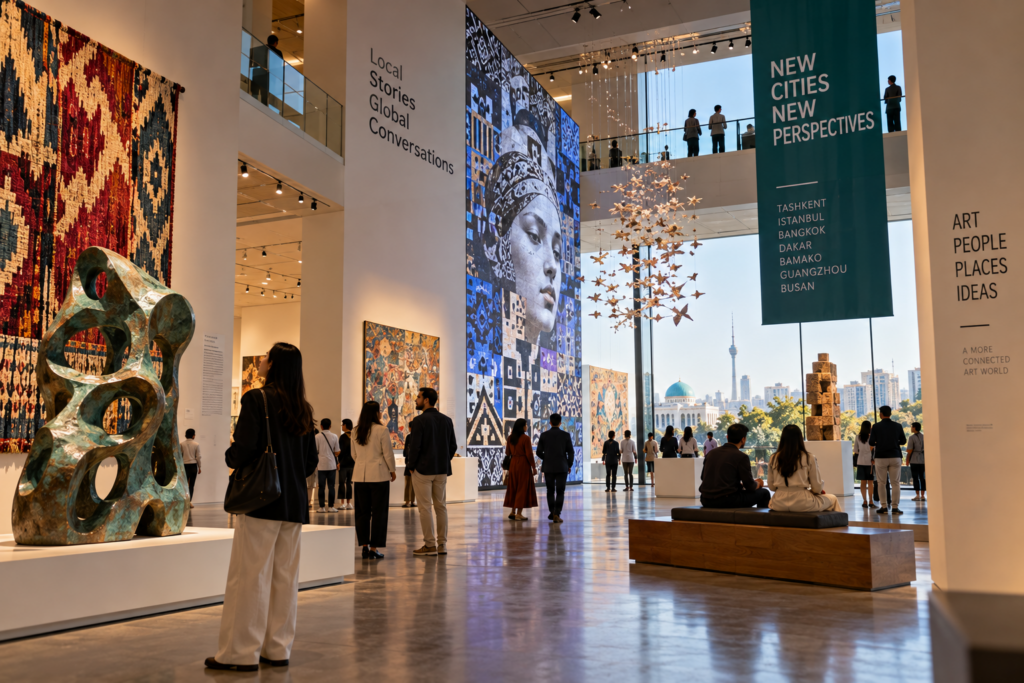
For much of the modern era, the international art world had a recognizable geography. A relatively small group of cities dominated the conversation, attracting the largest galleries, museums, collectors, critics and artists. Paris and London shaped European culture, New York became a center of the global contemporary art market, and a handful of other established capitals played similarly important roles.
That geography has not disappeared, but it is becoming less complete.
Art is increasingly moving through a much wider network of cities. New museums are opening in places that were previously peripheral to the international art circuit. Biennales are bringing artists and curators to cities across Asia, Africa, the Middle East and Latin America. Collectors are becoming more geographically diverse, while artists increasingly move between different cultural environments rather than building their careers around a single established center.
The change is not simply about the number of exhibitions taking place around the world. It reflects a deeper transformation in who gets to shape the conversation about contemporary culture.
The international art world is becoming more connected, but it is also becoming more distributed.
The Old Art Capitals Are No Longer the Whole Story
London, New York, Paris and other established centers still possess enormous advantages. They have major museums, mature galleries, established collector networks, art schools, auction houses and decades of accumulated cultural infrastructure.
Those advantages do not disappear simply because new cities become more ambitious.
What is changing is the assumption that an artist or institution must pass through one of these traditional centers to become internationally visible.
The growth of regional art fairs, biennales, independent galleries and new museums has created additional routes into the international art world. An artist can develop a practice in one city, exhibit at a biennale in another, work with a gallery somewhere else and reach collectors through a global digital network without permanently relocating to one of the traditional capitals.
The economics of the art world are also contributing to this change. Art Basel’s 2026 analysis of Asia identified Singapore, Japan and Thailand as increasingly important markets, while Hong Kong continues to occupy a leading position. The report points to changing wealth patterns and a maturing collector base as important forces behind the emergence of new regional hubs.
This does not mean that the old centers are losing their importance. It means that they are increasingly operating within a larger system.
Asia Is Building a More Diverse Art Network
Asia provides perhaps the clearest example of this transformation.
For decades, Hong Kong was one of the region’s most important international art markets, connecting Asian collectors and institutions with galleries from Europe and North America. That role remains significant, but other cities are developing stronger cultural identities of their own.
Singapore, Tokyo, Seoul and Bangkok are increasingly important destinations for galleries, collectors and artists, while cities such as Busan and Gwangju have built international reputations through major exhibitions and biennales.
The 2026 calendar illustrates how extensive this network has become. The Busan Biennale, Gwangju Biennale and upcoming Bangkok Art Biennale are all part of a much larger international exhibition circuit that now includes dozens of recurring events outside the traditional European and North American centers.
The significance of these events goes beyond tourism.
A biennale can give artists access to international curators without requiring them to enter the commercial gallery system first. It can bring local audiences into contact with international practices while also presenting local artists to visitors from abroad.
Over time, that can create an ecosystem of curators, writers, educators, galleries and collectors around the institution.
A city does not become an art center simply because it hosts one major exhibition. It becomes one when the exhibition contributes to a continuing cultural infrastructure.
The Gulf Is Building a New Cultural Position
Another major shift is taking place across the Middle East.
The region has invested heavily in museums, galleries, cultural districts and major art events, creating institutions that are beginning to influence the international art calendar rather than simply participating in it.
The launch of Art Basel Qatar in 2026 was particularly significant. According to Citi’s 2026 State of the Art Market report, the event reflected growing attention toward the Middle East and North Africa, supported by expanding local wealth and substantial investment in cultural infrastructure. More than half of the participating galleries came from the Middle East, North Africa and South Asia.
The importance of such initiatives is not limited to the market.
Cultural investment can create museums, archives, educational programs, public art projects and opportunities for artists who previously had fewer international platforms. It can also encourage institutions to reconsider which histories and artistic traditions are represented in major exhibitions.
This is where the growth of new art centers becomes culturally significant.
A new museum is not simply another building. It can change the questions that are being asked.
Africa Is Building Its Own International Circuit
The African art scene is also becoming more visible through an expanding network of exhibitions and institutions.
Cities such as Dakar, Lagos and Bamako have long been important cultural centers, but their significance is increasingly being recognized within the broader international art system. Major recurring events provide platforms for artists whose practices may not fit comfortably within the traditional narratives of European and North American contemporary art.
The 2026 international calendar illustrates the scale of this activity. Dak’Art in Dakar is scheduled for November, followed later that month by Bamako Encounters in Mali, while the Lagos Biennial is also part of the year’s international program.
These events matter because they allow cultural conversations to develop in their own environments.
An artist working in Dakar does not necessarily need to explain every aspect of their practice through the expectations of London, Paris or New York. The local context can become part of the international conversation rather than something that has to be translated into an established Western framework.
This creates a more complicated global art world, but also a more interesting one.
The Global South Is Challenging Old Cultural Narratives
One of the most important consequences of this geographical expansion is the growing influence of artists and curators from the Global South.
For much of the twentieth century, international art history was often organized around institutions and movements in Europe and North America. Artists from other regions were frequently included through exhibitions that positioned their work as evidence of cultural difference rather than as part of equally complex artistic histories.
That model is increasingly being questioned.
The 2026 Venice Biennale provides a useful example. Artists such as South Africa’s Thania Petersen are presenting work that connects local histories to much broader geographies of migration, religion and cultural exchange. Petersen’s project explores the movement of Sufi music across the Indian Ocean and uses textiles to connect Southern African history with wider transnational narratives.
The importance of such work lies partly in its refusal to treat geography as a limitation.
A work can be deeply rooted in a particular place while simultaneously addressing histories that cross national borders. Migration, colonialism, trade, religion and cultural exchange have always connected societies, and contemporary art is increasingly making those connections visible.
The global art world is therefore becoming less interested in a simple division between “Western” and “non-Western” art.
The more interesting question is how different histories intersect.
Cities Want More Than an Art Fair
There is also an economic reason why cities are investing in culture.
A major art fair or biennale can attract international visitors, but the longer-term objective is often to create a cultural ecosystem that remains active throughout the year.
That means museums, galleries, artist studios, educational institutions, public spaces, restaurants, design businesses and creative communities all become part of the equation.
A city that manages to develop these connections can benefit from cultural activity far beyond ticket sales.
Artists need affordable studios. Curators need institutions willing to take risks. Galleries need collectors. Students need education. Audiences need regular exhibitions rather than one annual event.
The challenge is that cultural infrastructure cannot be created entirely through investment in spectacular buildings.
A museum can provide an important foundation, but it needs people and ideas around it.
This is why some of the most interesting new art centers are developing through a combination of major institutions and smaller independent initiatives. The large museum creates visibility, while smaller organizations provide experimentation.
A healthy art ecosystem requires both.
New Institutions Are Changing the Meaning of Cultural Investment
The opening of a major cultural institution can also signal a broader change in how a city understands itself.
The recently inaugurated Centre for Contemporary Arts in Tashkent, for example, has been presented as part of a broader effort to strengthen the city’s position as an international cultural center. The institution occupies a restored early twentieth-century power station and combines contemporary art with industrial heritage and new public spaces. The development forms part of a wider cultural investment that includes the planned national museum designed by Tadao Ando and the growing importance of the Bukhara Art Biennial.
The example is interesting not because one new institution can suddenly transform the global art map, but because it illustrates how cultural ambition is increasingly being expressed through architecture, museums, biennales and international partnerships at the same time.
Tashkent is also preparing its 11th International Biennale of Contemporary Art in October 2026. The event will bring international and Uzbek artists into museums and galleries across the city and is built around the theme “Event Horizon,” focusing on the human condition at a moment of technological and cultural change.
These developments demonstrate how a city can use contemporary art to connect local identity with international cultural networks.
Digital Culture Is Making Geography Less Absolute
The rise of digital platforms has accelerated this process.
An artist no longer needs to wait for a gallery in a major capital to discover their work. Images can circulate internationally within hours, exhibitions can be documented and discussed online, and collectors can encounter artists without physically visiting their studios.
But digital visibility does not eliminate geography.
Art still depends heavily on physical relationships. Artists meet curators at exhibitions. Collectors visit galleries. Institutions build reputations through programs that unfold over many years. Major works have to be transported, conserved and displayed somewhere.
The digital world therefore makes the art system more connected without making physical places irrelevant.
In fact, the more culture circulates digitally, the more valuable certain physical experiences can become. A major exhibition offers something that an image on a screen cannot fully reproduce: scale, material presence, architecture, atmosphere and the experience of encountering other people around the same work.
The future of the global art world is likely to depend on both systems working together.
The New Art Map Is More Networked Than Hierarchical
The most important change may be that the global art world is gradually becoming less hierarchical.
The old model resembled a pyramid, with a small number of dominant centers at the top and many other cities positioned below them. The emerging model looks more like a network, with different cities becoming important for different reasons.
One may have strong museums. Another may have a dynamic artist community. Another may specialize in contemporary art from a particular region. Another may attract collectors, while another develops influential biennales.
No single city needs to dominate every part of the system.
This does not mean competition has disappeared. Cities still compete for museums, artists, galleries, collectors and major cultural events. But the competition itself is helping create a more diverse cultural landscape.
The result is an art world in which audiences can move between different centers rather than following one established route.
What a More Global Art World Could Mean
A more geographically diverse art world does not automatically become a fairer one.
New cultural institutions can reproduce old inequalities if they simply import established models without supporting local artists and communities. Major investments can create impressive buildings without creating sustainable creative ecosystems. International attention can also turn local culture into a marketable image without engaging seriously with its complexity.
The challenge is therefore not simply to create more art centers.
It is to create institutions that allow different cultural perspectives to influence the international conversation on their own terms.
That requires long-term investment in artists, education, archives, independent organizations and local audiences. It also requires international institutions to approach new regions as sources of ideas rather than simply as new markets.
The most successful cultural centers will probably be those that understand this distinction.
They will not try to become another London or New York. They will build on what makes their own cultural environment distinctive while establishing connections with the rest of the world.
A World With More Than One Cultural Center
The international art world is not becoming less global. It is becoming global in a different way.
Artists are moving across borders more frequently. Collectors are looking toward new markets. Museums are establishing international partnerships. Biennales are expanding the number of cities capable of hosting serious cultural conversations. At the same time, new institutions are giving local artists platforms from which they can participate in global debates without abandoning the contexts from which their work emerged.
The result is a cultural landscape that is more complicated than the old map of major art capitals.
That complexity is valuable.
When more cities become places where art can be produced, discussed and exhibited, more histories enter the conversation. Different ideas about beauty, identity, memory, politics and society become visible. Audiences gain access to artistic traditions that might previously have remained outside the dominant international circuit.
The future of the art world may therefore belong less to a handful of capitals and more to a network of cultural centers connected by artists, exhibitions, institutions and audiences.
The map is expanding, but the more important change is what happens when that expansion changes the conversation itself.
Art has always crossed borders. What is changing now is who gets to decide which stories deserve to travel.