The New Economics of Sustainability: Why Businesses Are Rethinking Growth
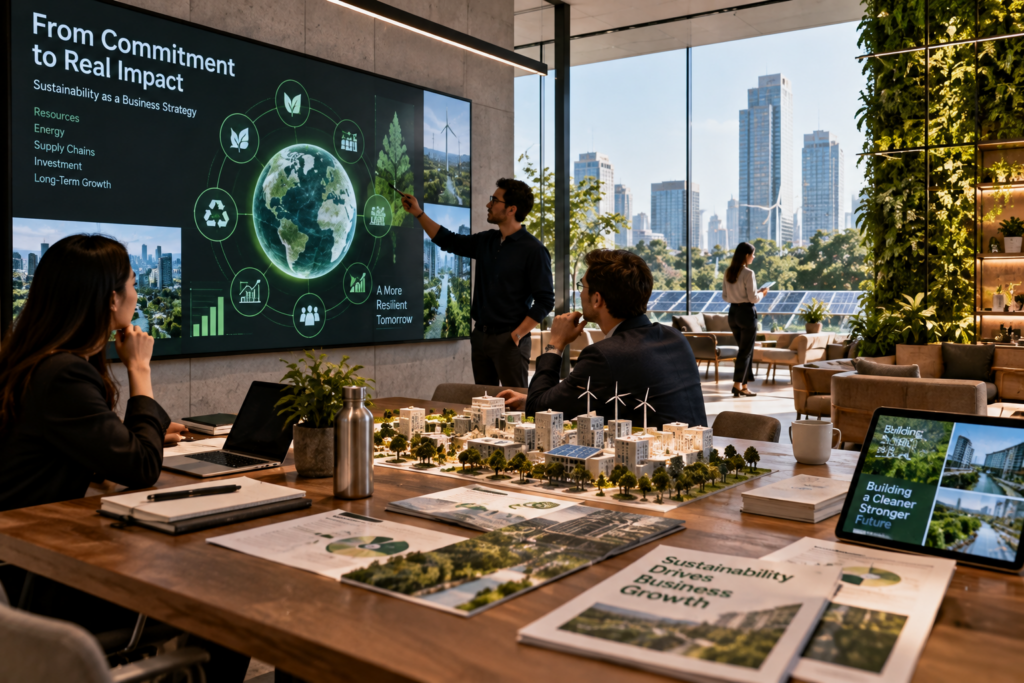
For years, sustainability was often treated as a separate layer of corporate strategy. Companies published environmental targets, launched recycling programmes, purchased renewable energy and issued reports describing their social and environmental commitments. These initiatives could improve a company’s reputation, but they were not always connected to the decisions that determined how the business actually operated.
That relationship is changing. In 2026, sustainability is increasingly being pulled into the centre of business planning because the issues it addresses are becoming financial issues as well. Energy costs, resource scarcity, climate-related disruption, supply-chain volatility, changing regulations and investor expectations can all affect revenue, margins and long-term competitiveness. A company does not have to be an environmental business for these pressures to matter.
Recent research from Capgemini shows how much the corporate conversation has shifted. Its 2026 sustainability study, based on more than 1,000 senior sustainability leaders across energy, life sciences, manufacturing, retail and transportation, describes sustainability as increasingly connected to cost control, risk management, procurement, supply chains and investment decisions. The emphasis is moving from sustainability as a statement of intent towards sustainability as part of business resilience.
Sustainability Is Becoming a Business Calculation
The most important change may be the disappearance of the old division between environmental responsibility and commercial performance. When a manufacturer reduces energy consumption, for example, the result is not simply a smaller environmental footprint. It can also mean lower operating costs and less exposure to energy-price volatility.
The same logic applies to materials. A company that depends heavily on a scarce commodity has a direct financial interest in using that material more efficiently, finding alternatives or recovering it from products at the end of their useful lives. Waste can become a cost that needs to be eliminated, while efficient resource use can become a competitive advantage.
This is one reason sustainability is increasingly appearing in decisions that traditionally belonged to finance, operations and procurement departments. The question is no longer simply whether a company has an environmental target. Executives are increasingly asking how resource efficiency affects margins, how climate risks could interrupt production and whether suppliers will remain reliable as environmental requirements change.
The World Economic Forum’s 2026 Chief Sustainability Officers’ Outlook reflects this transition. Among the 103 sustainability leaders surveyed, 63% expected sustainability progress either to remain steady or accelerate over the following year. The report also identifies a stronger business case and cheaper, more applicable technologies as major potential accelerators, while policy uncertainty, short-term economic pressures and geopolitical volatility remain important obstacles.
That combination is revealing. Sustainability is gaining commercial importance at the same time that companies are becoming more selective about where they spend money.
The End of Easy Sustainability
The business case for sustainability is becoming stronger, but the economics are not necessarily becoming easier.
Companies are operating in an environment where capital remains expensive, supply chains are being redesigned and investment decisions are increasingly influenced by geopolitical risk. Sustainability projects therefore have to compete with every other demand on corporate budgets.
Morgan Stanley’s 2026 Sustainable Signals research illustrates this tension. More than 90% of the sustainability leaders surveyed said their companies were continuing to make progress, yet 47% believed there was room for improvement in execution. Investment requirements were identified as the most common barrier, while macroeconomic uncertainty had also become a much more significant constraint than in the previous year.
This changes the type of sustainability projects that attract attention. A project with a clear financial return may move ahead quickly because it can defend itself in a conventional investment discussion. A project whose benefits are distant, difficult to measure or dependent on uncertain future regulation may face a much harder path.
The result is not necessarily a retreat from sustainability. It is a more demanding approach to it.
Businesses increasingly need to demonstrate that sustainability can protect value, create value or reduce risk. Environmental benefits remain important, but they are increasingly being considered alongside the practical economics of implementation.
Supply Chains Are Becoming Part of the Sustainability Equation
One of the clearest examples can be found far beyond a company’s own factories and offices.
Modern businesses depend on complex networks of suppliers, transport companies, processors, energy providers and logistics infrastructure. A sustainability strategy that focuses only on a company’s direct operations can therefore miss some of the most significant risks in its business model.
Environmental requirements are increasingly affecting access to markets and the way global supply chains operate. The OECD reported in 2026 that supply chains are being reshaped by both digital transformation and a growing wave of environmental requirements linked to market access. Efficiency, resilience and environmental performance are becoming increasingly connected rather than separate objectives.
For companies, this means procurement departments are becoming more important to sustainability strategy. Choosing a supplier is no longer simply a question of price, quality and delivery time. Depending on the sector, businesses may also need to consider emissions, resource use, labour conditions, traceability and the ability of suppliers to meet changing environmental requirements.
This can be complicated, particularly for smaller companies that supply much larger organisations. At the same time, it creates pressure for better data. Companies cannot manage risks in a supply chain if they have little visibility into how products are made, transported or sourced.
The sustainability transition is therefore becoming partly a data problem. Businesses need reliable information about resources, emissions, suppliers and operational risks if they want to make better decisions.
Regulation Is Changing the Cost of Doing Business
Regulation is another reason sustainability has moved closer to the centre of corporate strategy.
The European Union provides one of the clearest examples. In July 2026, the European Commission adopted revised European Sustainability Reporting Standards designed to simplify reporting while maintaining information on environmental, social and governance risks. The revised framework reduces the number of mandatory data points by more than 60% and is expected to reduce reporting costs by more than 30% per company.
The significance goes beyond the European market. Large international companies increasingly operate across jurisdictions with different reporting and due-diligence requirements. Their suppliers may also face demands for sustainability information even when they are not directly subject to the same regulations.
The OECD’s 2026 Responsible Business Outlook found that 84% of OECD member countries have introduced some form of due-diligence-related regulation, covering areas such as sustainability reporting, business conduct and product or market measures. The report also found that public commitments remain much more common than detailed disclosure of outcomes, highlighting the continuing gap between corporate promises and measurable implementation.
For business leaders, this makes sustainability increasingly difficult to treat as a communications exercise. Claims have to be supported by systems, records and operational changes.
Investors Are Looking Beyond the Sustainability Label
Capital markets are also changing the conversation.
Sustainable investment has gone through periods of intense enthusiasm, political criticism and market uncertainty. Yet the underlying consideration of environmental and social risks has not disappeared. The 2026 FTSE Russell survey of 402 asset owners across 24 countries found that 84% were incorporating sustainability considerations into investment decisions, up from 73% in 2025. At the same time, the quality of corporate reporting and disclosure was identified as a major barrier to wider sustainable investment adoption.
This points towards a more mature stage of sustainable finance. Investors do not necessarily need every company to tell the same sustainability story. They need enough reliable information to understand exposure to risks and the quality of management decisions.
A company with efficient factories, resilient suppliers and a credible plan for adapting to environmental regulation may therefore appear more attractive for reasons that have little to do with corporate image. Sustainability becomes part of understanding whether a business can continue to operate successfully under changing conditions.
The Opportunity Is Moving Into the Main Economy
The sustainability economy is also expanding beyond the traditional clean-energy sectors.
In 2026, the World Economic Forum identified more than 50 investible opportunities across 13 sectors where environmental benefits can coincide with financial returns or cost savings. The areas highlighted include precision agriculture, sustainable cement, battery recycling and industrial water management. The Forum estimates that these opportunities could contribute up to $10.1 trillion in annual business revenues and cost savings by 2030.
That is important because it changes the scale of the sustainability discussion.
The transition is not limited to solar panels, electric vehicles or renewable-energy companies. It increasingly reaches industries such as construction, agriculture, manufacturing, water management, materials and waste.
In these sectors, sustainability can mean using less material, reducing energy consumption, recovering valuable resources, extending product lifetimes or making industrial systems more efficient. Some of the most important innovations may therefore be relatively invisible to consumers because they happen inside factories, warehouses, farms and infrastructure networks.
Growth Will Have to Become More Resource-Aware
The central challenge is that the world still needs economic growth while facing tighter environmental constraints.
Businesses cannot simply stop expanding. Growing populations need housing, transport, food, energy, healthcare and consumer goods. Developing economies need industrial investment and infrastructure. Companies still need to increase productivity and create new markets.
The question is increasingly about how that growth is achieved.
Clean investment reached almost $2 trillion globally in 2025 across clean power, transportation, manufacturing and low-carbon industry, according to Rhodium Group. Yet its 2026 mid-year update found that global clean investment was 17% lower in the first half of 2026 than during the same period of 2025. The decline shows how sensitive the transition remains to financing conditions and broader economic pressures.
This makes efficiency particularly important. A sustainable economy cannot depend entirely on ever-increasing amounts of capital flowing into new technologies. It also needs existing systems to use energy, materials, land and infrastructure more intelligently.
That may ultimately prove to be one of the most important changes in corporate thinking. The future of sustainability is not simply about adding cleaner products to an existing economic model. It is about redesigning the model so that growth becomes less dependent on waste and increasingly compatible with resource constraints.
From Corporate Promise to Operating Strategy
The next phase of sustainability will probably be less visible in corporate advertising and more visible in operational decisions.
It will appear in the materials selected by product designers, the suppliers chosen by procurement teams, the efficiency of factories, the resilience of logistics networks and the way companies allocate capital. It will influence which technologies receive investment and which older systems are replaced.
That does not mean every sustainability decision will produce an immediate financial return. Some investments will remain long-term commitments, particularly where companies are preparing for climate risks that may become more severe over decades. Others will require regulation or market changes before they become commercially attractive.
But the direction is increasingly clear. Sustainability is moving closer to the core questions that businesses have always asked: What will this cost? What could disrupt us? Where can we become more efficient? Which markets will grow? What will investors expect? And what kind of company will remain competitive ten or twenty years from now?
The new economics of sustainability is therefore not about choosing between growth and responsibility. It is about recognising that, in a world of constrained resources, changing climate conditions and more demanding markets, the two are becoming increasingly difficult to separate.