The Sustainable City of the Future: How Urban Life Is Being Redesigned Around Resources
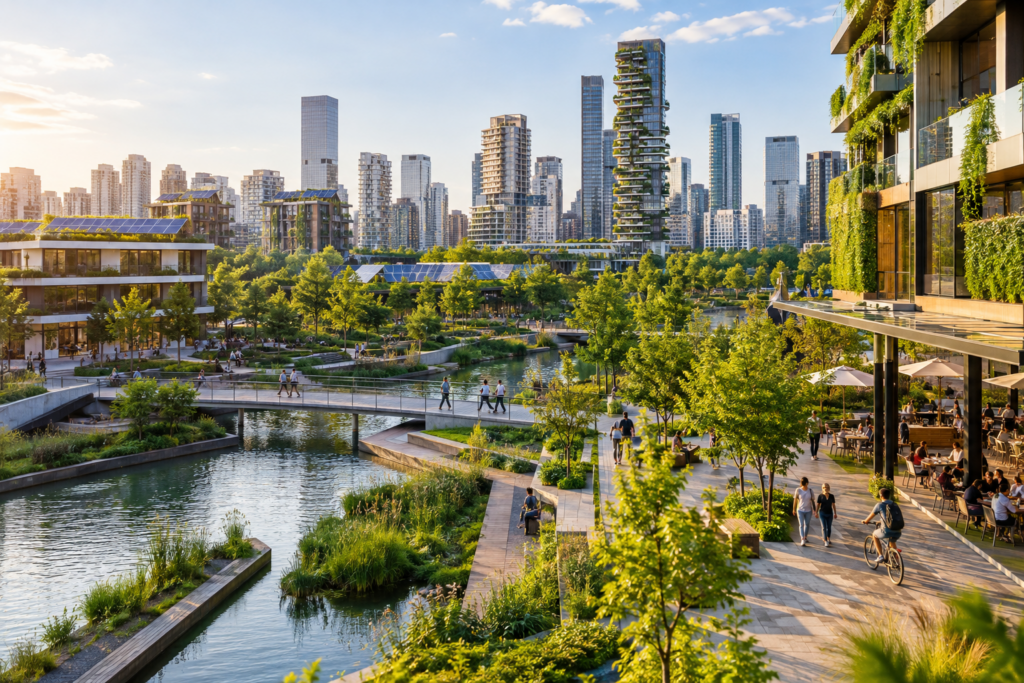
A city can look modern and still be wasteful. Glass towers may rise above crowded roads, new residential districts may spread across the outskirts, and shopping areas may offer every convenience of contemporary life. Yet beneath that image, the city may depend on ageing water systems, energy-intensive buildings, long car journeys and infrastructure that struggles whenever temperatures rise or heavy rain arrives.
This contradiction is changing the way urban development is understood. Sustainability is no longer simply a question of adding parks, installing solar panels or introducing electric buses. It increasingly concerns the way a city uses resources as a connected system: how energy reaches buildings, how water moves through streets and homes, how construction materials are consumed, how people travel and how neighbourhoods respond to environmental stress.
The challenge is becoming more urgent as urban populations grow and climate pressures intensify. Cities concentrate people, businesses and infrastructure in relatively small areas, creating enormous opportunities for efficient services and innovation. The same concentration, however, can amplify risks when housing is poorly designed, green space disappears or essential systems are unable to cope with heat, flooding and water shortages.
The sustainable city of the future will therefore be defined less by a collection of visible green features than by how well its different systems work together. Its success will depend on whether residents can live comfortably while the city uses fewer resources, produces less waste and remains functional under increasingly difficult conditions.
The City Must Be Designed as One System
Urban problems are often addressed separately. Transport planners focus on congestion, energy specialists work on electricity supply, housing departments deal with affordability, and environmental teams try to protect green spaces. Each task matters, but decisions in one area can easily undermine progress in another.
A new housing development, for example, may use efficient building materials and modern insulation, yet create additional environmental costs if residents have to drive long distances for work, education and essential services. A city may expand its public transport network, but the benefits will remain limited if residential districts and workplaces are poorly connected to stations. Even an attractive park can deliver less value if it is isolated from surrounding neighbourhoods or lacks the trees and vegetation needed to provide meaningful shade.
This is why integrated urban planning is becoming central to sustainability. The goal is not simply to make individual buildings or services more efficient, but to organise the city so that people and resources move through it more intelligently.
UN-Habitat’s World Cities Report 2026 places climate-resilient housing within a broader discussion of urban vulnerability and social equity. Its analysis highlights the relationship between housing quality, exposure to climate hazards and access to essential services, particularly for residents with limited resources. A sustainable city cannot be considered successful if its newest districts perform well while large parts of its population remain exposed to unsafe housing, extreme heat or inadequate infrastructure.
This perspective changes the meaning of urban sustainability. It becomes a question of how the whole urban environment functions, not simply how environmentally advanced its most impressive buildings appear.
Buildings Are Becoming Part of the Climate Solution
Buildings sit at the centre of the urban sustainability challenge because they influence energy demand, material consumption, water use and the everyday comfort of residents. Their impact begins long before anyone switches on a light or adjusts a thermostat. It starts with the materials used in construction, the location of the building, its orientation towards the sun and the way it is designed to respond to local weather.
For many years, energy efficiency was largely associated with adding better insulation, installing efficient equipment and replacing outdated lighting. Those improvements remain valuable, but designers are increasingly looking at the relationship between a building and its surroundings. Window placement, shading, ventilation, roof design and the use of thermal mass can all affect how much energy a building needs to remain comfortable.
In hot climates, for example, reducing direct solar exposure can be just as important as installing more efficient cooling equipment. In colder regions, insulation and airtight construction can reduce heating demand, while well-designed ventilation helps maintain indoor air quality. These solutions differ according to climate, but they share the same principle: buildings should respond intelligently to their environment instead of relying entirely on mechanical systems to correct poor design.
The next challenge is extending this approach across entire neighbourhoods. Buildings affect one another through shade, wind patterns, reflected heat and the density of development. Streets lined with suitable trees can reduce exposure to direct sunlight, while green roofs and shaded public spaces may help moderate local temperatures. At the same time, poorly planned density can place additional pressure on water systems, transport networks and public services.
The most sustainable building is therefore not necessarily the one with the most advanced technology. Its performance depends on its design, location, materials, maintenance and relationship with the wider city.
Green Space Is Becoming Essential Infrastructure
Parks and urban trees have traditionally been valued for their beauty, recreation and contribution to public health. Their role is now being understood in more practical terms as cities search for ways to cope with extreme heat, manage rainwater and protect biodiversity.
Trees can provide shade, vegetation can help absorb rainfall, and wetlands can retain water that might otherwise overwhelm drainage systems. Green corridors can connect habitats across developed areas, while well-designed public spaces can make neighbourhoods more comfortable during hot weather. These benefits depend on local conditions and careful maintenance, but they demonstrate why nature is increasingly being treated as part of urban infrastructure rather than as decoration.
Recent data from CDP illustrates the growing interest. Its August 2026 analysis found that 55% of reporting cities, states and regions were using nature-based solutions as climate adaptation measures. The same analysis identified substantial funding needs: local governments reported a requirement for US$34 billion for adaptation projects and US$3 billion for nature-related projects.
The figures reveal both momentum and a serious implementation gap. Many local governments recognise the value of working with nature, but recognising a solution does not automatically provide the money, land, expertise or maintenance capacity needed to deliver it.
Urban greenery also needs to be distributed fairly. A city can boast a spectacular central park while residents in densely populated districts have little access to trees or shaded streets. If green infrastructure is concentrated in affluent areas, the benefits of lower temperatures, cleaner surroundings and accessible recreation will be unevenly shared.
The next generation of sustainable urban planning will need to consider not only how much green space exists, but where it is located, who can reach it and whether it performs the environmental functions the city needs.
Water Will Shape the Next Phase of Urban Planning
Water is one of the clearest examples of why sustainable cities must think beyond individual buildings. Urban areas require reliable supplies for households, businesses, industry, sanitation, public services and green spaces. At the same time, climate change can make rainfall less predictable, intensify droughts in some regions and increase the risk of destructive flooding in others.
Traditional urban water systems often separate these challenges. Water is collected and treated for consumption, rainwater is channelled away through drainage networks, and wastewater is processed before being discharged. In a more resource-conscious city, these systems can increasingly be planned together.
Rainwater harvesting can provide water for uses that do not require drinking-quality supplies, while treated wastewater can support certain industrial processes, irrigation and other suitable applications. Permeable surfaces and carefully designed green spaces can help rainfall soak into the ground rather than immediately entering drainage systems. Wetlands and other nature-based solutions can also contribute to water management when they are appropriately designed and maintained.
These approaches do not eliminate the need for conventional pipes, reservoirs, treatment plants or flood defences. Instead, they can complement existing infrastructure and reduce pressure on it. The right combination depends on local rainfall, geology, water quality, land availability and public-health requirements.
Planning is especially important because water problems rarely remain confined to one neighbourhood. Excessive groundwater extraction, polluted rivers and poorly managed drainage can affect entire metropolitan regions. Sustainable urban water management therefore requires cooperation between municipalities, utilities, regional authorities and the communities that depend on shared resources.
As cities grow, the ability to use water efficiently and recover it safely may become just as important to their long-term competitiveness as access to energy or transport.
Transport Must Bring Daily Life Closer Together
Transport remains one of the most visible dimensions of sustainable urban development, but the discussion is gradually moving beyond the choice between petrol and electric vehicles. Electrification can reduce tailpipe emissions and improve local air quality, yet it does not by itself resolve congestion, long commuting distances, road safety or the amount of urban space devoted to moving and parking cars.
A more sustainable transport system gives residents practical alternatives. Reliable public transport, safe walking routes, protected cycling infrastructure and well-connected neighbourhoods can reduce dependence on private vehicles. The objective is not to eliminate cars from every city, but to make driving one option among several rather than a necessity for almost every journey.
This depends heavily on land-use decisions. When homes, schools, shops, healthcare facilities and workplaces are located far apart, even efficient public transport may struggle to serve every journey. When daily needs are closer together, residents can often complete more trips on foot, by bicycle or through a combination of public transport and walking.
Compact development can also make public services more efficient because infrastructure serves more people within a smaller area. But density alone is not a guarantee of sustainability. Overcrowded districts without adequate parks, ventilation, public services or comfortable pedestrian routes can become difficult places to live, particularly during extreme heat.
The most effective approach combines density with accessibility and quality of life. Streets need to work as public spaces, not merely channels for traffic. Transit stations should connect with surrounding neighbourhoods, and new developments should be planned around the everyday journeys residents actually make.
When transport and land use are considered together, sustainability becomes less about asking people to make individual sacrifices and more about creating an urban environment in which lower-impact choices are also convenient.
Waste Is a Resource Management Problem
Every city produces a continuous stream of discarded materials, from food scraps and packaging to electronics, construction debris and industrial waste. The conventional response has often been to collect this material and move it away from where people live. But disposal does not make the resource problem disappear; it simply transfers it to another location.
A sustainable city begins by reducing the amount of material that becomes waste in the first place. Repair and reuse systems can extend the life of consumer products, while better construction planning can reduce unused materials and make components easier to recover. Separate collection and effective processing can return suitable materials to production, and food-waste prevention can reduce both disposal costs and the resources used to produce food that is never eaten.
These systems require more than recycling bins. Cities need collection infrastructure, sorting facilities, markets for recovered materials and clear responsibilities for businesses and residents. If recovered materials have no reliable buyers, even well-organised collection programmes can struggle to become financially viable.
Construction offers a particularly important opportunity because buildings contain large quantities of materials that may retain value when a structure is renovated or demolished. Designing buildings for adaptation, documenting the materials they contain and planning for careful disassembly can make future recovery easier. Such measures may require more work at the beginning, but they can reduce waste and preserve materials that would otherwise be lost.
The wider objective is to replace the idea of waste as an unavoidable endpoint with a system that continually asks how materials can remain useful. That approach connects urban waste management with procurement, building design, industrial policy and local employment.
Digital Technology Can Help, but It Cannot Plan the City Alone
Modern cities are generating increasing amounts of data through electricity meters, transport systems, water networks, environmental sensors and digital public services. Used well, this information can help authorities identify leaks, understand traffic patterns, anticipate energy demand and respond more quickly to infrastructure problems.
Digital tools can also improve the way cities plan for climate risks. Mapping heat exposure, flood-prone areas, tree cover and population density can reveal which neighbourhoods need investment most urgently. When these datasets are combined with information about housing quality and access to services, planners can develop a more complete picture of urban vulnerability.
Yet technology is not a substitute for sound planning or public accountability. Sensors cannot compensate for a neglected water network, and a sophisticated digital model will not make a city resilient if its recommendations are never translated into funded projects. Data can also be incomplete, difficult to compare or concentrated in areas with better monitoring systems, potentially obscuring the needs of less visible communities.
There are practical limits as well. Digital infrastructure consumes energy and materials, and its long-term value depends on maintenance, cybersecurity and the ability of public agencies to use the information effectively. Cities should therefore assess digital projects by the problems they solve rather than by how advanced the technology appears.
The most useful smart-city systems will often be those residents barely notice: a water leak repaired before it becomes a major failure, a bus network adjusted to actual demand, or a heat-risk map that helps direct trees and shade to the streets that need them most.
The Cost of Sustainability Must Be Shared Fairly
Even when sustainable infrastructure offers long-term benefits, the initial cost can be difficult to manage. Retrofitting old buildings, modernising water networks, expanding public transport and restoring degraded land all require substantial investment. Local governments may face limited budgets, while residents can struggle with higher housing costs or the expense of upgrading inefficient homes.
This creates a central tension in urban sustainability. A city may become greener and more efficient overall while becoming less affordable for some of the people who live there. New parks and improved public spaces can increase the appeal of neighbourhoods, but without appropriate housing policies, rising property values and rents may push existing residents away from the benefits created around them.
The same issue arises with energy-efficient buildings. Lower energy consumption can reduce household bills over time, but the upfront cost of improvements may be beyond the reach of lower-income households. Public programmes, financing mechanisms and targeted assistance can help make upgrades more accessible.
Climate resilience must also account for unequal exposure to risk. Residents in poorly insulated housing, informal settlements or flood-prone areas may face greater danger while having fewer resources to recover. Investment decisions should therefore consider who receives the benefits, who bears the costs and which communities need protection first.
A sustainable city is not simply one that reduces its environmental footprint. It must also provide safe housing, accessible services and a reasonable quality of life. If the transition increases inequality or makes daily life unaffordable, its long-term success will be difficult to sustain.
The Future City Will Be Measured by How Well It Works
The sustainable city of the future may not be defined by a single architectural style or a uniform set of technologies. One city may prioritise water reuse because supplies are limited. Another may focus on flood protection, while a third needs to reduce energy demand or provide reliable public transport for a rapidly growing population. Local climate, geography, income levels and existing infrastructure will determine which investments matter most.
What these cities will share is a more integrated understanding of urban resources. Buildings will be designed in relation to their surroundings, transport will be connected to land use, water systems will be planned around both supply and rainfall, and materials will be managed with their future recovery in mind. Nature will increasingly be considered part of the infrastructure that protects urban life, while digital tools will help cities understand how their systems perform.
Progress will not depend on innovation alone. It will require long-term planning, reliable funding, cooperation across public agencies and meaningful participation from residents. It will also demand a willingness to maintain existing infrastructure rather than concentrate all attention on new projects.
Ultimately, sustainability is becoming a test of how intelligently cities organise everyday life. The best urban environments will not necessarily be the ones with the most visible green technology. They will be the places where homes remain comfortable during heatwaves, water systems withstand pressure, public transport makes daily journeys easier, materials retain their value and neighbourhoods offer a good quality of life without consuming resources unnecessarily.
That is the deeper ambition behind the sustainable city: not to make urban life look greener, but to make it work better for people while reducing the environmental costs of providing the things they need.