The Circular Economy Is Growing Up: How Products Are Being Designed for a Second Life
For most of the industrial era, the life of a product was easy to understand. Raw materials were extracted, turned into components, assembled into a finished product, sold to a customer and eventually discarded. The system was remarkably effective at producing abundance, but it was built around a simple assumption: once something stopped being useful to its first owner, its economic value was largely over.
That assumption is becoming harder to defend.
A smartphone can contain valuable metals long after its screen breaks. A washing machine may need a relatively small replacement part rather than an entirely new appliance. A piece of industrial equipment can remain productive for years if it is maintained properly. Even packaging, furniture and construction materials can have a second or third life when products are designed with reuse and recovery in mind.
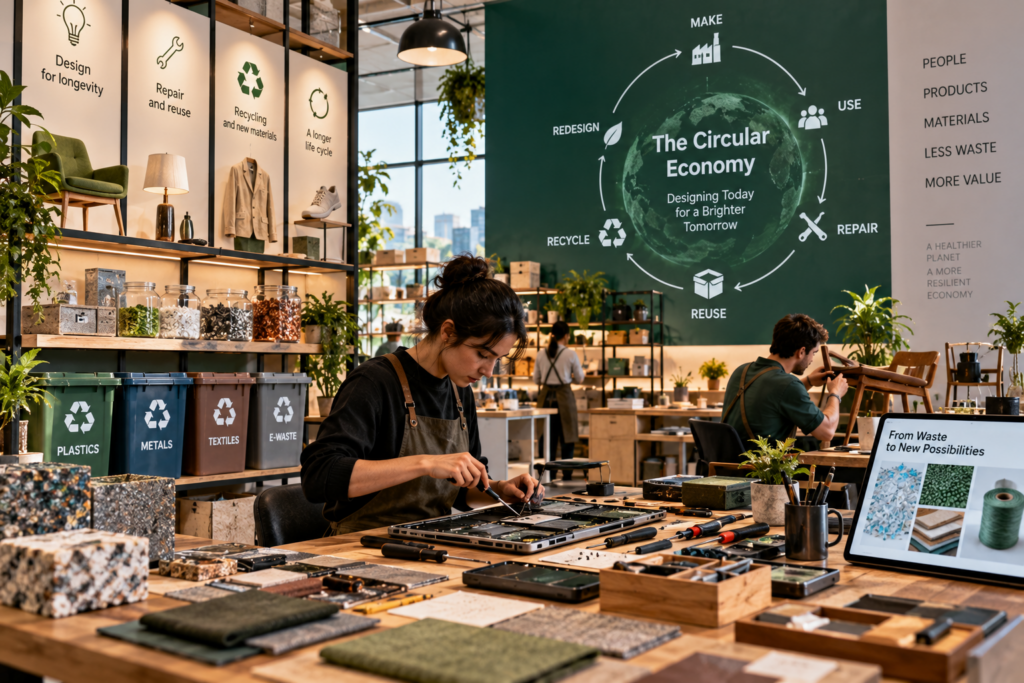
This is the idea behind the circular economy, but the concept is becoming more ambitious than recycling alone. In 2026, the focus is increasingly shifting toward keeping products, components, materials and the value embedded in them in use for as long as possible. That means designing things differently from the beginning.
The Circular Economy Is About More Than Recycling
Recycling remains an important part of the circular economy, but it is only one stage of a much larger system.
When a product is recycled, its materials are recovered after the original product has already reached the end of its useful life. By contrast, repair, maintenance, refurbishment, reuse and remanufacturing can preserve much more of the value already invested in the product.
Consider a laptop. If it is thrown away because its battery has degraded, recycling can recover some of its metals and other materials. But replacing the battery may allow the entire computer to remain useful for several more years. The second option preserves not only material value but also the energy, manufacturing effort, software, transport and labour that went into producing the original machine.
This distinction is becoming increasingly important as companies and policymakers look for ways to reduce resource consumption without simply replacing one form of waste with another.
The 2026 Circularity Gap Report introduced a new way of looking at the problem. Instead of measuring circularity only by the share of secondary materials entering the economy, it estimates the amount of economic value lost through inefficient material use, premature disposal, waste and deterioration. Its initial estimate puts this global “Value Gap” at €25.4 trillion a year, equivalent to almost 31% of global GDP.
The figure is an estimate rather than a measure of money that could simply be recovered, and the report stresses important methodological limitations. But its significance lies in the question it raises: how much economic value disappears because products and resources are used inefficiently?
That question changes the circular economy from a waste-management issue into a design and productivity issue.
The Product Has to Be Designed Differently
Circularity begins long before a product reaches a recycling facility.
A manufacturer deciding how a product will be assembled is also deciding how easy it will be to repair. The choice of materials affects whether components can later be separated. The availability of spare parts determines whether a broken product can be restored. Software support can influence how long an electronic device remains functional, while modular construction can make upgrading easier without replacing an entire product.
This is why product design has become one of the most important areas of the circular economy.
For decades, many products were optimised primarily for manufacturing efficiency, appearance, performance and price. Durability and repairability mattered, but they were not always dominant considerations. The circular approach asks manufacturers to think about the entire life cycle before production begins.
The question becomes broader: What happens when the first owner no longer wants the product? Can another person use it? Can a component be replaced? Can the product be refurbished? Can valuable materials be separated? Can the product be upgraded rather than discarded?
These questions can influence everything from screws and adhesives to software architecture and supply-chain planning.
Repair Is Becoming Part of the Market
One of the clearest signs that circularity is moving from theory into everyday commerce is the growing political and regulatory emphasis on repair.
The European Union’s new right-to-repair rules began applying on 31 July 2026. For covered products, consumers can request repairs from manufacturers when the products are technically repairable under EU law. The rules also improve access to repair information and spare parts, while choosing repair rather than replacement during the legal guarantee period can extend the guarantee by at least 12 months.
The policy covers products including washing machines, vacuum cleaners, mobile phones and tablets, among other categories. The European Commission expects the measures to generate around €4.8 billion in growth and investment, illustrating how repair is increasingly being treated not simply as an environmental service but as an economic activity in its own right.
This could change the economics of ownership.
If repair becomes easier, consumers may be less likely to replace a product at the first sign of failure. Manufacturers may also have to think more carefully about spare-parts availability, service networks and the long-term support of products.
A new repair economy can emerge around the original product: independent technicians, refurbishment companies, parts suppliers, resale platforms and specialised maintenance services all become part of the value chain.
The European Commission is also developing an online European Repair Platform, expected to become operational in 2027, intended to make it easier for consumers to find suitable repair services.
The larger implication is significant. The end of a product’s first sale no longer has to mean the end of its economic life.
Manufacturers Are Starting to Think in Life Cycles
For businesses, this creates both an opportunity and a challenge.
A company built around selling as many replacement products as possible could find that longer product lifetimes reduce the frequency of new purchases. But the same company could also develop new revenue streams through repairs, upgrades, subscriptions, refurbishment, certified resale or product-as-a-service models.
That requires a different relationship with the customer.
Instead of seeing a product as a single transaction, manufacturers can increasingly view it as a long-term asset. A washing machine can generate value through maintenance and replacement parts. Industrial machinery can be monitored, upgraded and remanufactured. Electronics can move through several owners while remaining within the manufacturer’s broader ecosystem.
This is particularly relevant for expensive products and equipment where the value of the original materials and components is high.
It also creates an incentive to design for durability. A product that can be refurbished reliably has a very different economic profile from one that has to be dismantled and discarded after a few years.
The circular economy therefore does not necessarily mean selling less. It can mean creating more value from each product over a longer period.
The Second Life Is Becoming a Design Objective
The phrase “second life” is often associated with used goods, but the concept is becoming much broader.
A second life can mean a phone passed to another owner, an industrial motor refurbished for another application, a vehicle component remanufactured for use in a new machine, or building materials recovered during demolition and incorporated into another structure.
This creates a hierarchy of value.
If a product can be reused almost unchanged, much of its original value remains. If it can be repaired or refurbished, a large proportion of its structure and components can be preserved. Remanufacturing can recover complex components and restore them to a high standard. Recycling becomes particularly important when the product can no longer be kept intact.
The longer value can remain at a higher level of this hierarchy, the less energy and material may be required to recreate the same function from scratch.
The 2026 Circularity Gap Report identifies premature obsolescence and inefficient management of products and materials as major mechanisms behind economic value loss. It estimates that mismanagement of products and materials accounts for roughly €6.2 trillion in annual value loss, while premature disposal of long-lived assets is another major source of lost value.
That suggests a fundamental change in how manufacturers should think about durability. A longer-lasting product is not simply a more environmentally responsible product. It can also be a way of preserving economic value that would otherwise disappear.
New Business Models Follow the Product
Once products are designed to last longer, the business model around them can change as well.
A traditional manufacturer earns most of its revenue when a customer purchases a new product. A circular business can continue generating revenue during the product’s life through maintenance, upgrades, refurbishment, replacement components or resale.
In some industries, customers may not even need to own the product.
Equipment-as-a-service models allow companies to pay for access to machinery rather than purchasing and replacing it outright. Manufacturers then have a stronger incentive to keep equipment operational because their revenue depends on continued performance.
This can create an unusual alignment of interests. The customer wants a reliable product that works for longer, while the manufacturer has a financial reason to maintain and upgrade it rather than simply sell a replacement.
The model is not suitable for every product or industry, and circular business models can introduce their own logistical and financial complexities. But the broader principle is becoming increasingly relevant: companies can make money from keeping products useful rather than from making them disposable.
Materials Are Becoming Strategic Assets
The circular economy is also changing how companies think about raw materials.
For decades, manufacturers could largely assume that the materials they needed would be available through global commodity markets. That assumption is becoming less comfortable as resource demand grows and supply chains face geopolitical, environmental and logistical pressures.
Recovering materials from existing products can therefore become a form of supply security.
Old buildings contain metals, glass, timber and other materials. Retired electronics contain valuable components and minerals. Used batteries contain materials that can potentially be recovered and returned to manufacturing systems. Industrial waste streams can sometimes become inputs for another production process.
This creates what can be thought of as an urban and industrial stock of resources. Materials already present in the economy do not necessarily have to be extracted again from nature.
The challenge is developing the systems needed to recover them efficiently. Collection, sorting, testing, transportation and processing all cost money. Circularity works best when the value of recovered materials or products is high enough to support the infrastructure required to bring them back into productive use.
That is why circular design and circular logistics have to develop together.
The Biggest Challenge Is Changing Consumer Expectations
Technology and regulation can encourage circularity, but consumer behaviour remains important.
For many years, newness has been closely associated with value. A newer phone, car, appliance or piece of furniture can be marketed as more desirable simply because it is newer. Repair, by contrast, has sometimes been perceived as an inconvenience or as a sign that a product is becoming obsolete.
The circular economy challenges that assumption.
A well-designed product that can be repaired, upgraded and maintained for ten years may ultimately offer greater value than one that performs slightly better when new but becomes difficult to support after a few years.
This does not mean consumers will suddenly stop wanting new products. Fashion, technology and changing preferences will continue to drive demand. But the market can evolve toward a more flexible relationship between new, used, repaired and refurbished products.
Resale platforms have already demonstrated that a product can move between owners without losing its economic identity. The next stage is to connect resale with repair, refurbishment and manufacturer support so that the product remains part of a functioning value chain rather than simply becoming someone else’s unwanted item.
Circularity Is Becoming an Economic Strategy
The circular economy is often presented as an environmental vision, but the deeper transformation is economic.
The traditional linear model creates value quickly by moving materials through extraction, production, consumption and disposal. The circular model tries to slow that process down. It asks businesses to preserve the value already embedded in products, components and materials rather than repeatedly paying to recreate it.
The 2026 Circularity Gap Report describes this as a shift from focusing primarily on resource efficiency toward maximising the value of resources over time. Its analysis identifies end-of-life waste, energy losses, food waste, processing losses and the deterioration of fixed assets as interconnected sources of economic loss.
That is a much broader proposition than simply recycling more bottles or collecting more electronics.
It means designing factories that waste fewer materials, buildings that can be adapted rather than demolished, products that can be repaired, machines that can be remanufactured and supply chains that can recover useful resources. It also means developing financial models that recognise the value of durability and long-term asset utilisation.
The circular economy is therefore moving into a more mature phase. Its central question is no longer only what happens to a product after it is thrown away. The more important question is what could have been done differently so that throwing it away was unnecessary in the first place.
That shift has consequences for designers, manufacturers, retailers, policymakers and consumers alike. A product’s future may increasingly be considered before its first sale, and its second life may become part of the original business plan.
The most successful circular products will not necessarily look unusual. They may look like ordinary phones, appliances, machines, vehicles or pieces of furniture. The difference will be hidden in how they are designed, maintained, repaired, reused and eventually taken apart.
That is where the circular economy is growing up: not in the recycling bin at the end of the process, but in the decisions made at the very beginning.